DIRECTV
Sales & Services Writing Guide
A writing style guide for use by the Acquisition and Services UX teams at DIRECTV.

DIRECTV
A writing style guide for use by the Acquisition and Services UX teams at DIRECTV.
I was initially hired at DIRECTV to edit UX content before it was passed to developers. Because of the sheer amount of work that went into each design and writing sprint, there wasn’t enough time for me to review all content before it was passed from the UX team to developers. We quickly realized we needed to adjust our expectations for my role and find a better solution for aligning content across the sales and services pages.
DIRECTV had a lot of voice guidelines for content writing and some guidance on branded language, but we didn’t have any internal source materials for language style and specific writing requirements. I drafted a living style guide which was used by two UX teams to help streamline some common language and formatting situations that would arise in our work.
How can we make the content on DIRECTV’s sales and services pages appear more uniform and less like it was written by a number of different writers?
A living writing guide that was continually edited when new situations and questions arose about how to write content for DIRECTV pages.
This writing guide was used by 6 different writers spread across two teams. It was used to help in drafting hundreds of pages and modals throughout the DIRECTV sales flow and the DIRECTV existing customer and legal services flows.
The actual guide is a word document with a version history at the top of the document laying out when content was added or changed.
The guide contains references and links to several external resources, including Microsoft’s Style Guide, the Chicago Manual of Style, and the American Heritage Dictionary.
Whenever I encountered a unique style question, or whenever a colleague asked my input on a specific style question, I would research the question in online source materials like Microsoft’s Style Guide or the Chicago Manual of Style. I would also consult with writers from different teams and explore how DIRECTV has previously handled the content. After answering my colleague, I would use my answer as a template for a section in the writing guide.
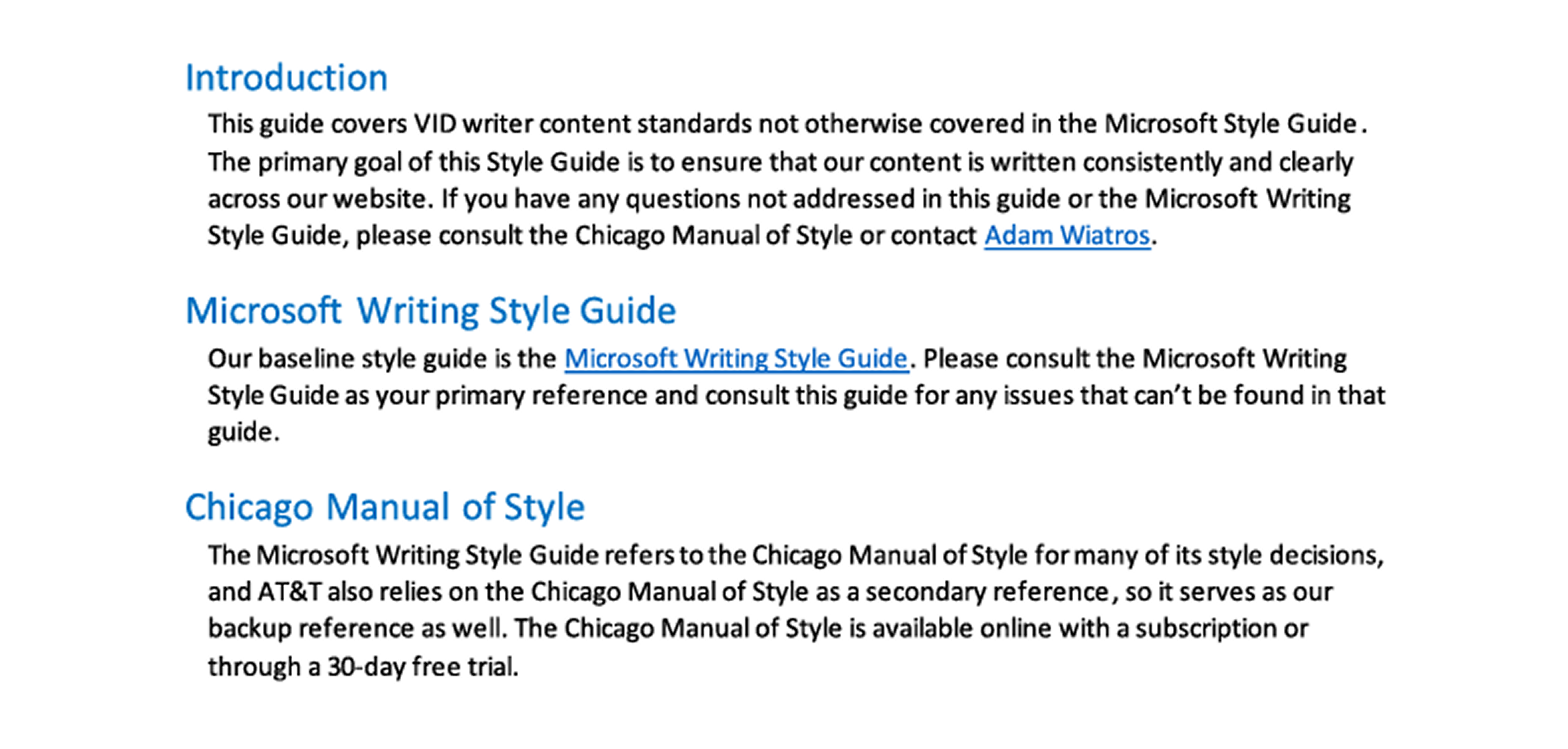
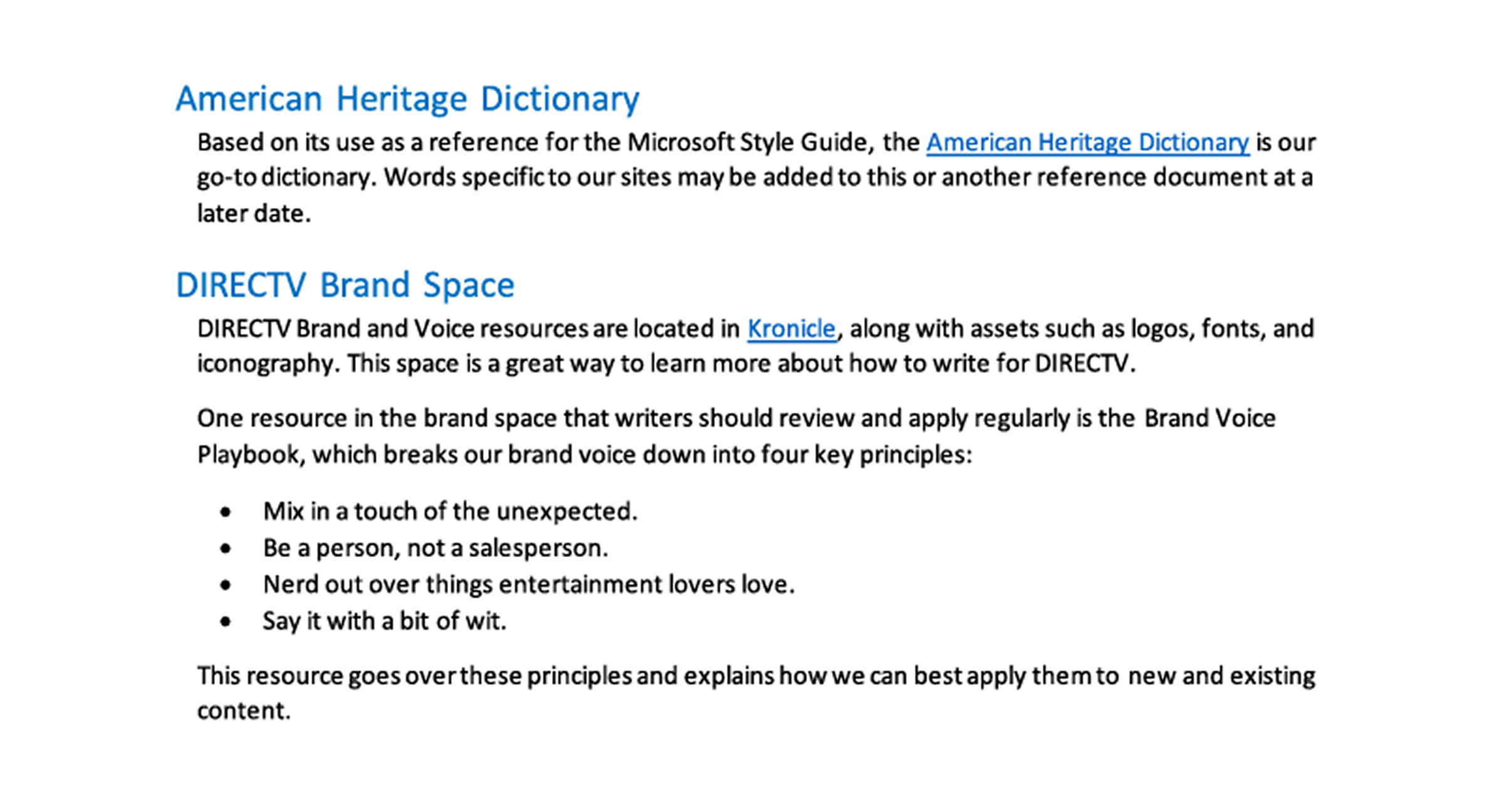
The first section of the writing guide includes instructions for finding guidance outside of the guide. It included references to the Microsoft Writing Style Guide, the American Heritage Dictionary, and DIRECTV's internal brand space, which provided additional insight into brand voice.

Punctuation is another large portion of the guide, explaining when to use or avoid using specific punctuation. Most of this guidance came from the source materials mentioned above, but some guidance was based on historic use on the DIRECTV website or, where there wasn't any guidance, on consensus between myself, my colleagues, and occasionally senior writers outside of the Sales and Services teams.

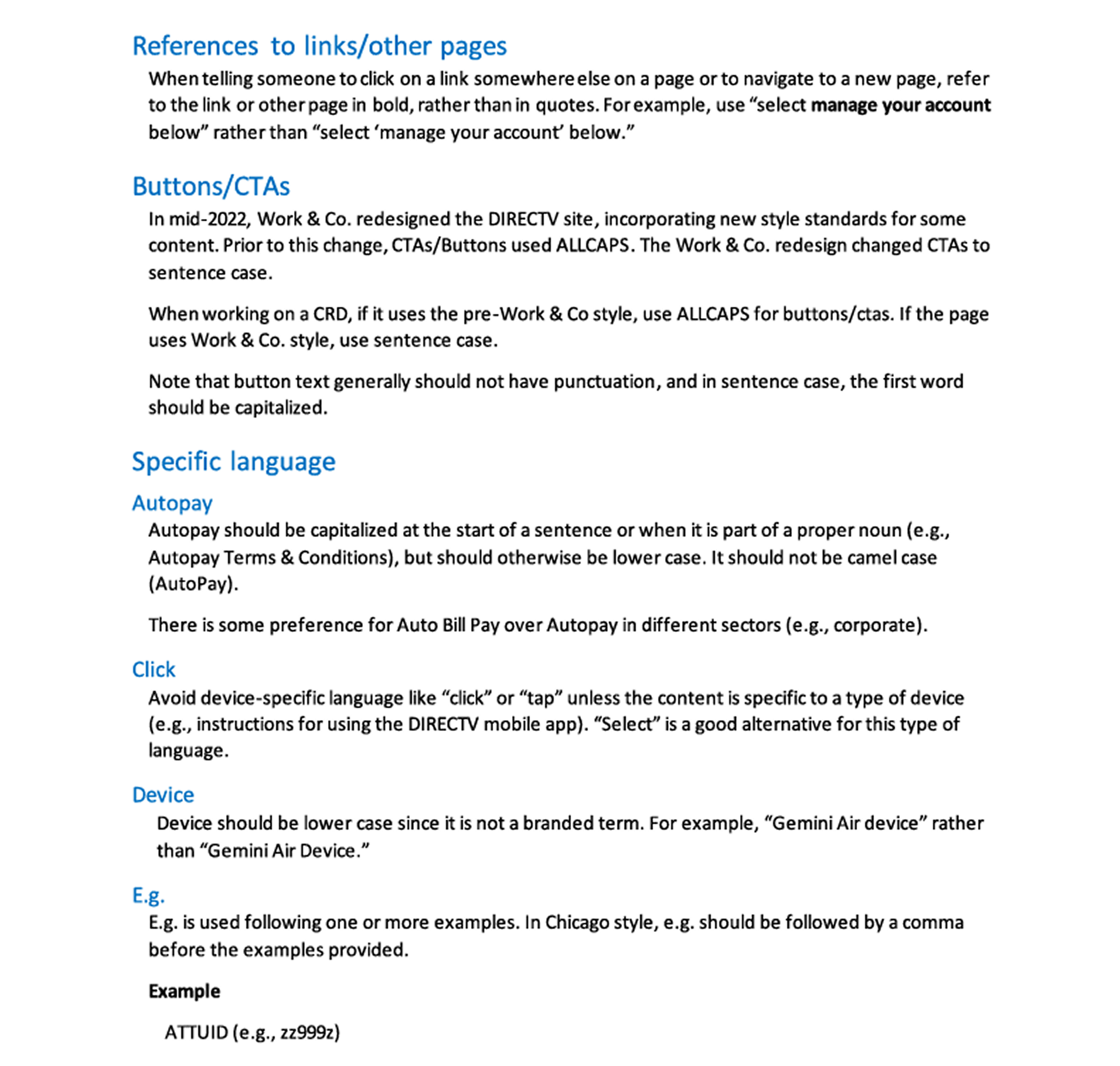
Occasionally, such as in the case of "autopay," there wouldn't be any consistency across teams. I would routinely encounter AutoPay, Auto pay, and auto-pay in the same flow on the DIRECTV site. When this happened and I couldn't get a clear consensus, I would research similar language on other competitor pages or elsewhere online, and would use that and my own preference to make a decision.
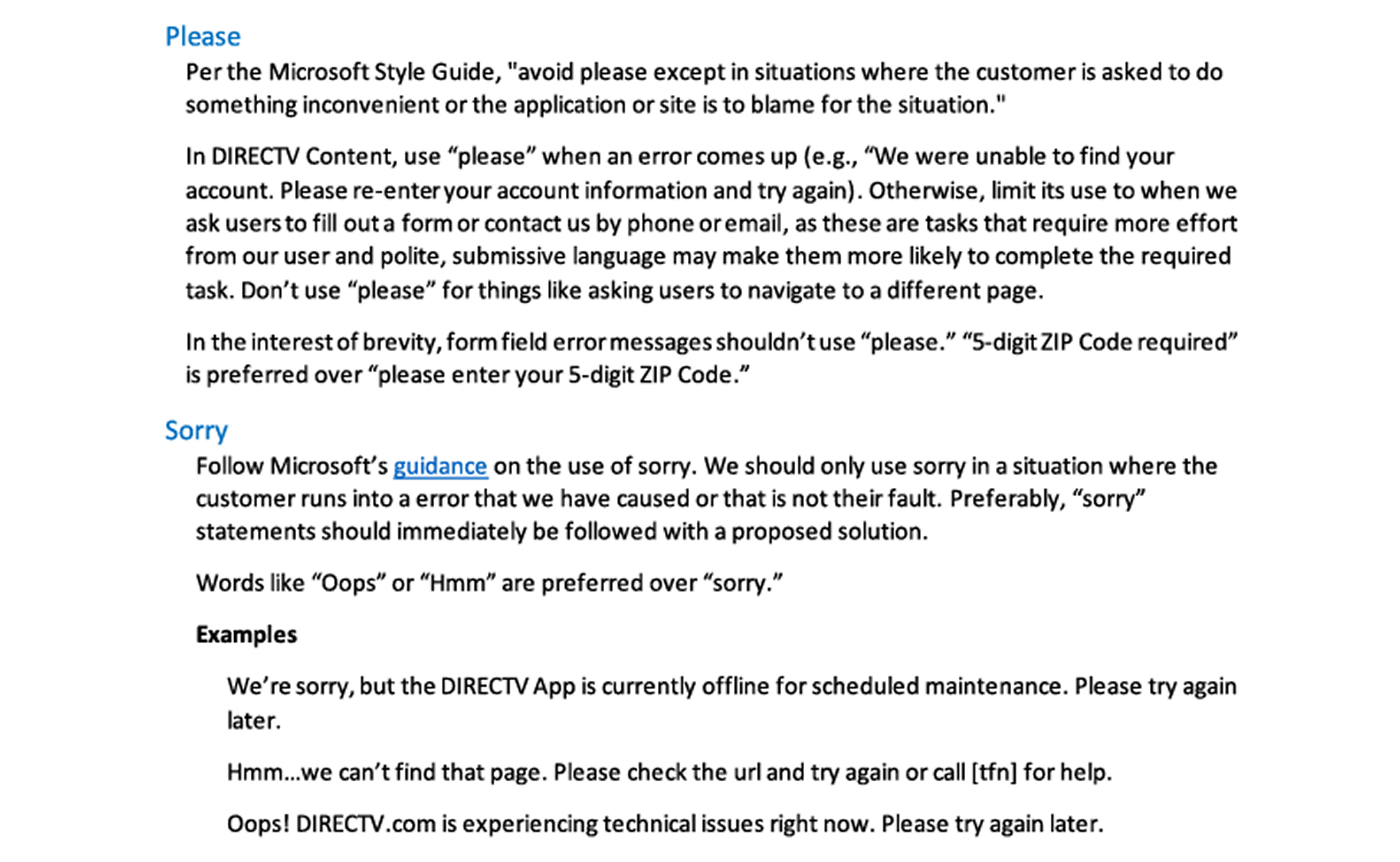
The guidance on "please" and "sorry" largely stems from my own experience working in customer-facing jobs and providing phone support, such as in my time as a Reference Attorney at Thomson Reuters. Trying the positive tone of our brand voice meant going against my extremely midwestern nature and cutting back on apologies and avoiding overuse of "please," which could come across as condescending. Fortunately, Microsoft and I agreed on this and I could lean on our primary writing resource to back me up.
The writing guide is a living document; it changes frequently by getting new sections that answer specific questions. It also is subject to change based on new guidance from other teams outside of Sales and Services. Now that my employment at DIRECTV has ended, I’ve passed ownership of the guide to the most senior writer on the Sales and Services team to continue maintaining and updating.
Trends in language change just like trends in visual design. As DIRECTV’s palette, logos, and imagery changed during my time at the company, so did the way we were writing. This meant I regularly needed to the guide and be prepared to make changes to DIRECTV's website to reflect changing trends.
One of the challenges with the style guide was knowing when something was important enough to include in the guide. Individual UX Writers are empowered to make content decisions on the fly, so it is very possible that there is more content that should have gone into the guide that writers were just making their own individual decisions on. It’s also possible that writers would miss or forget to check the guide, so there may still be deviations in content despite having a writing guide.
A two-week sprint format is a rapid timeline. Though not an ideal solution to this problem, the writing guide went a long way in stepping in where a content editor didn’t fit due to time constraints.